
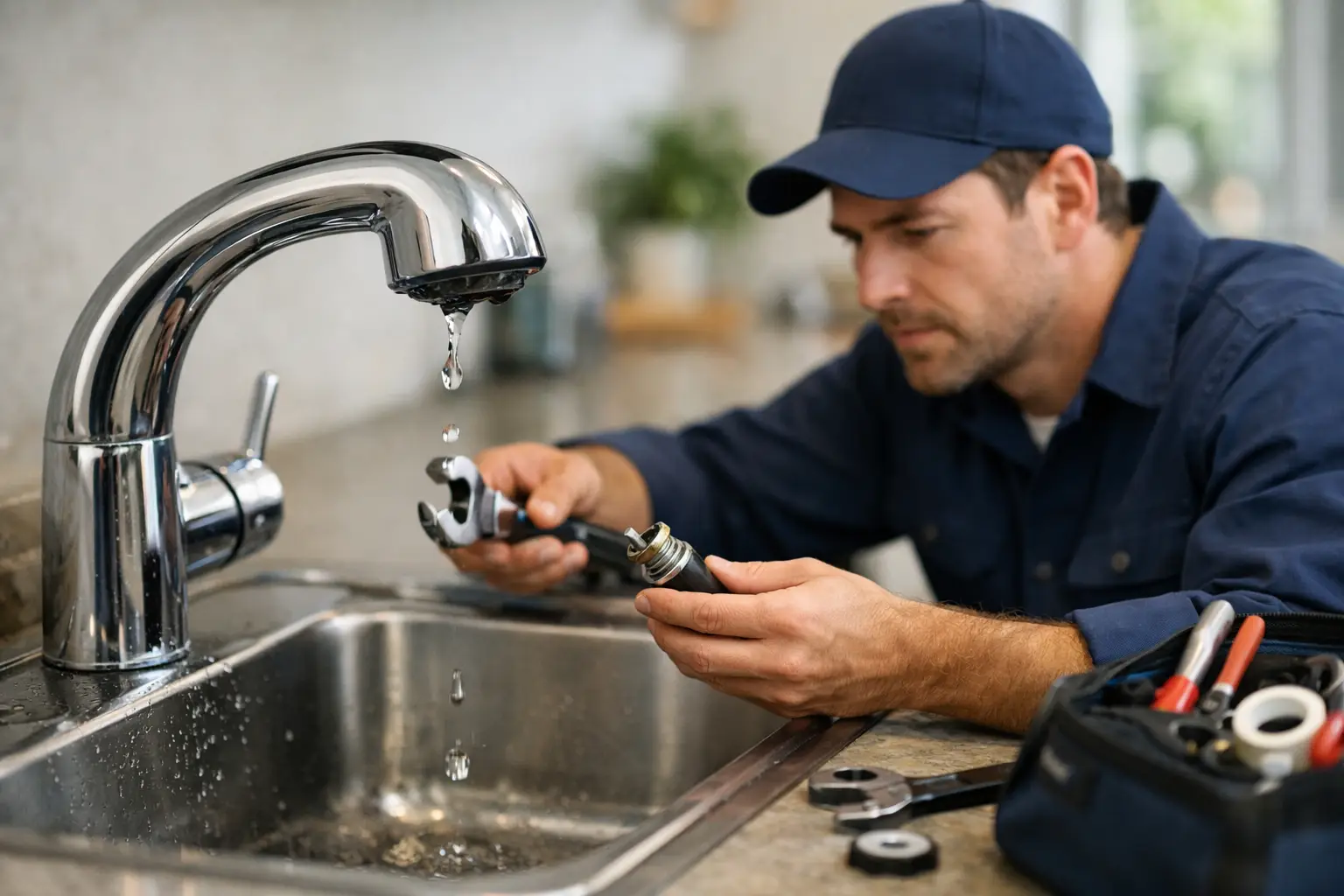


A faucet that drips every few seconds can be more than a nighttime annoyance. If you are asking, “why is my faucet leaking,” the answer is usually a small worn part, loose connection, or pressure issue that has been building over time. The good news is that many faucet leaks are repairable without replacing the entire fixture. The key is finding where the water is actually coming from before a minor problem damages the cabinet, countertop, or flooring below.
Why Is My Faucet Leaking From the Spout?
A leak from the spout after the handle is turned off is the most common faucet complaint. Water is getting past an internal part that should create a watertight seal. The exact part depends on the faucet style, but it is often a worn washer, O-ring, cartridge, valve seat, or ceramic disc.
Compression faucets, usually found in older homes, have separate hot and cold handles. They use rubber washers that press down to stop the water. Those washers eventually flatten, crack, or harden. A steady drip from a compression faucet often points to a washer or valve-seat problem.
Single-handle faucets commonly use a cartridge, ball assembly, or ceramic disc. When the cartridge wears out or debris damages the sealing surfaces, water can continue passing through the faucet even when the handle is in the off position. Replacing the correct cartridge can solve the problem, but faucet parts are not universal. Bringing the old cartridge or the faucet make and model to a hardware store helps avoid several frustrating trips.
Mineral buildup is another frequent cause in Southern California homes. Deposits can collect around the valve seat or inside the cartridge, preventing parts from seating properly. In some cases, cleaning works. In others, the buildup has already pitted the metal or damaged the internal seals, so replacement is the better repair.
A Leak at the Handle Usually Means a Different Repair
Water around the base of the handle is often mistaken for a spout leak. It usually means an O-ring, packing nut, or cartridge seal is worn. You may only notice it when the faucet is on, or when moving the handle from hot to cold.
A loose packing nut can sometimes be tightened carefully, but overtightening can make the handle hard to operate or damage the faucet. If tightening does not stop the leak, the internal seals likely need replacement. This is especially common on kitchen faucets that get heavy daily use.
For pull-down kitchen faucets, check whether water is coming from the handle, the hose connection beneath the sink, or the spray-head connection. Each has a different cause. A leaking hose connection may need a new washer or a secure fitting, while a worn pull-down hose often needs replacement rather than a patch.
Water Pooling Around the Faucet Base
A puddle at the faucet base is not always a failed seal. Sometimes water is splashing behind the faucet during normal use and running beneath the fixture. Wipe the area dry, then run the water while watching closely. If water appears around the base only when the faucet is operating, an internal seal or a loose mounting connection may be involved.
If water appears even when the faucet has not been used, look under the sink. A supply line, shutoff valve, drain connection, or dishwasher line may be leaking and allowing water to travel upward or collect near the base. Finding the true source matters because tightening the faucet will not fix a plumbing leak below the counter.
Check Under the Sink Before You Take Anything Apart
Place a dry paper towel under the faucet connections, supply valves, and drain pipes. Then turn on both hot and cold water and check for fresh moisture. Paper towels reveal slow drips that are easy to miss on metal pipes or inside dark cabinets.
Pay close attention to the flexible supply lines that connect the shutoff valves to the faucet. A small drip at a fitting may be caused by a loose connection, a failing washer, corrosion, or an aging line. Do not force rusty valves or fittings. Older shutoff valves can fail when disturbed, turning a small faucet repair into an urgent water shutoff situation.
Also inspect the cabinet floor and wall behind the pipes. Swollen particleboard, staining, peeling laminate, mildew odor, or soft flooring means the leak may have been present longer than expected. At that point, stopping the water is only the first step. The area should be dried and any damaged material should be assessed before mold or cabinet damage spreads.
Common Reasons a Faucet Starts Leaking
Faucets usually do not fail without warning. A drip may begin after a handle starts feeling stiff, after the water pressure changes, or after years of regular use. These are the most likely underlying causes:
- Worn washers, O-rings, and seals that no longer hold water back
- A damaged or clogged cartridge, ceramic disc, or ball assembly
- Mineral deposits or corrosion on the valve seat and internal components
- Loose mounting hardware, handle nuts, or hose connections
- High water pressure that puts extra strain on faucet parts
- A cracked faucet body, damaged hose, or failing supply line
The trade-off is simple: a basic seal replacement is usually a sensible repair, while a cracked body or discontinued cartridge can make replacement more practical. A quality faucet can often be repaired several times. A low-cost fixture with unavailable parts may cost more in labor and repeat leaks than it is worth.
Can You Fix a Leaking Faucet Yourself?
If you know how to shut off the water, have basic tools, and can identify the faucet type, a simple repair can be manageable. Turn off both supply valves beneath the sink first. Open the faucet to release pressure, plug the drain so small screws cannot disappear, and take photos as you remove parts. Those photos can make reassembly much easier.
The risk is not usually the washer or cartridge itself. It is damaging a decorative finish, stripping a handle screw, breaking a corroded valve, or installing the wrong part. It is also easy to reassemble a faucet with a twisted O-ring or a cartridge facing the wrong direction, which can cause continued leaking or reversed hot and cold operation.
Skip the DIY attempt if the shutoff valves do not fully close, the faucet is heavily corroded, water is leaking inside the cabinet, or you are unsure whether the issue is the faucet or the plumbing connection. A small leak can become expensive quickly when water reaches drywall, flooring, or a downstairs ceiling.
When It Is Time to Repair or Replace the Faucet
Repair makes sense when the fixture is solid, the finish is in good condition, and replacement parts are readily available. A new cartridge, seal kit, aerator, or hose can restore many kitchen and bathroom faucets for far less than installing a new fixture.
Replacement is often the better choice when the faucet body is cracked, corrosion is extensive, parts are obsolete, or leaks keep returning after proper repairs. It can also be a good time to replace a faucet that no longer fits how you use the sink. For example, a shallow kitchen faucet may create constant splashing, while an outdated bathroom faucet may have poor flow or a hard-to-clean finish.
If you choose a new faucet, confirm the number of mounting holes in the sink or countertop, the spread between handles for widespread models, and the clearance behind the faucet. A fixture may look right online but not fit the existing holes, backsplash, or vanity cabinet.
Do Not Ignore a Drip That Seems Minor
One occasional drip may not feel urgent, but it is still a sign that a seal is failing. More importantly, leaks below the sink can stay hidden until the cabinet bottom is damaged. A quick inspection now is easier than replacing swollen cabinetry later.
For homeowners and property managers who want the issue handled without trial and error, SparkCore Handyman Services can inspect the faucet, identify the source, and complete practical repairs or replacement with clear communication. A faucet should turn on cleanly, shut off completely, and leave your cabinet dry. If it does not, addressing it early is the simplest way to protect the space around it.