
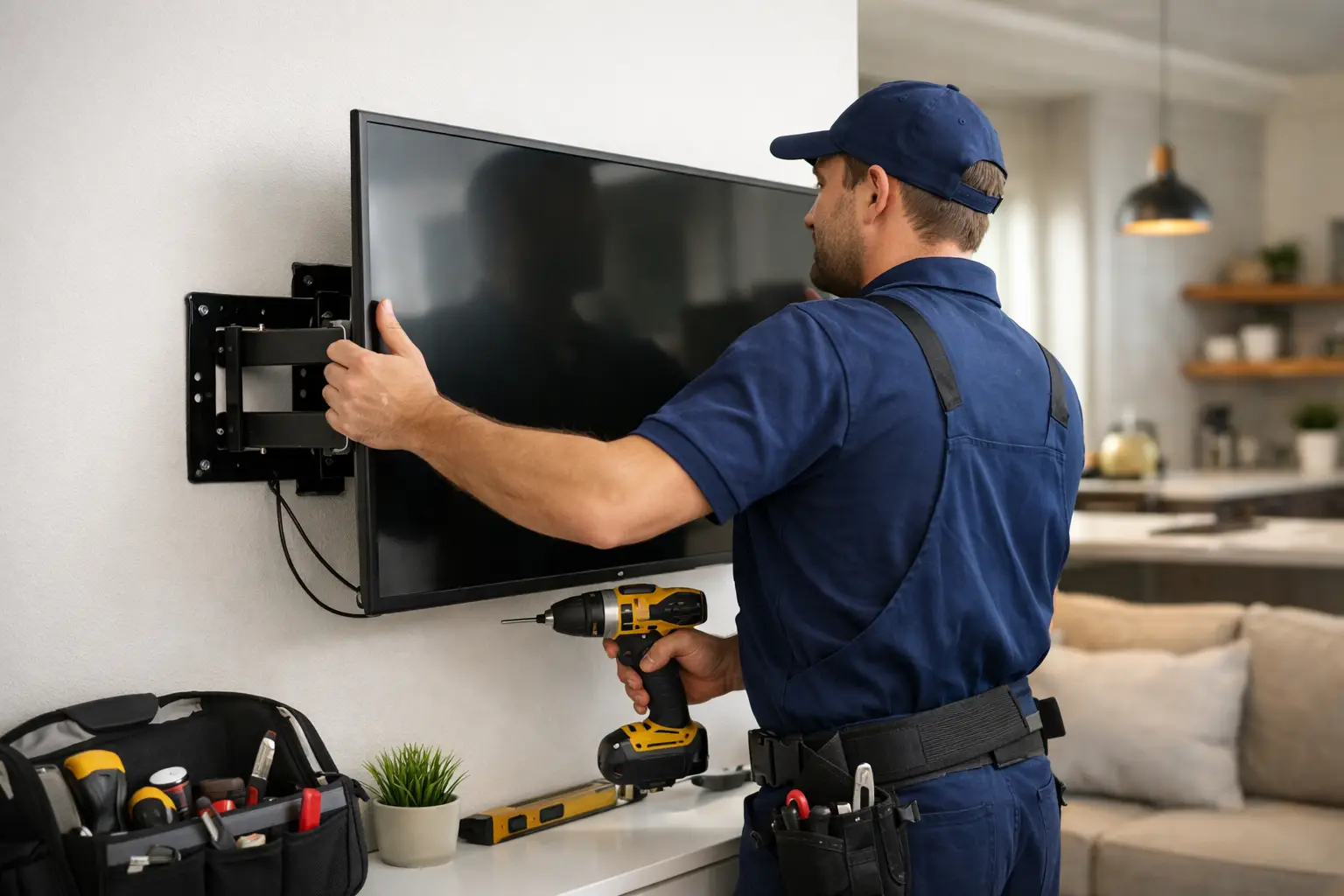


A new TV can look great in the box and still become a frustrating project once it is time to get it on the wall. The mount has to be secure, the screen needs to sit level, and the cables should not turn into a visible mess beneath it. So, can a handyman mount a TV? In most residential situations, yes – provided the handyman has the right experience, tools, and understanding of the wall behind the TV.
TV mounting is a common handyman job because it combines careful measuring, secure fastening, and basic assembly. But it is not a job to treat casually. A large TV is heavy, expensive, and often mounted above furniture, fireplaces, or floors where a fall could cause serious damage. The quality of the installation matters far more than how quickly the brackets go on the wall.
Can a Handyman Mount a TV Safely?
A qualified handyman can safely mount most TVs on standard drywall with wood studs, metal studs when the correct hardware is used, masonry, brick, or concrete. The key is determining what the wall is made of before drilling a single hole.
A good installer does more than hold up a bracket and start drilling. They confirm the TV size and weight, check the mount’s weight rating, locate studs or suitable solid backing, measure the desired viewing height, and make sure the mount is level. They also consider the room layout. A TV that is technically secure but mounted too high, too low, or off-center from the seating area will be annoying every day.
For many homeowners, hiring a handyman is the practical choice. It saves time, avoids a second set of hands problem, and reduces the risk of using the wrong anchors or mounting into an empty section of drywall. A dependable handyman should arrive with stud-finding tools, levels, drill bits, anchors, lag bolts, and the experience to know when a wall or installation request needs a different approach.
What a Proper TV Mounting Service Should Include
The basic work usually starts with assembling or inspecting the wall mount and attaching the correct bracket to the back of the television. From there, the wall plate is positioned, leveled, and secured to the proper structural support. The TV is then lifted onto the mount, locked in place, and checked for stability.
The details are where good workmanship shows. The installer should verify that the mount is rated for the television’s size and weight, not simply assume that any universal mount will work. They should use the mount manufacturer’s hardware when appropriate and avoid relying on light-duty drywall anchors for a heavy screen.
A professional installation also means discussing placement before the work begins. Homeowners often have a preferred wall but have not considered glare from windows, viewing distance, door swing clearance, or the location of power outlets. A few minutes of planning can prevent an expensive re-do.
Cable organization is another common part of the job. External cords can often be routed neatly through a surface-mounted raceway or organized behind a media console. Concealing cables inside a wall may be possible, but it has additional considerations, especially if electrical work is involved.
The Wall Type Makes a Big Difference
Not every wall should be mounted the same way. In Los Angeles homes, a handyman may encounter traditional drywall over wood framing, plaster walls in older properties, stucco, brick, concrete, or metal studs in condos and newer buildings. Each requires a different mounting method.
Drywall With Wood Studs
This is generally the most straightforward setup. A mount can be fastened directly into one or more wood studs using the correct lag bolts. Depending on the size of the TV and mount design, the wall plate may span two studs, which provides strong support and flexibility in placement.
A capable handyman will locate the studs accurately rather than assuming they are spaced evenly or trusting a stud finder without verification. Plumbing, electrical wiring, and other hidden elements also need to be considered before drilling.
Metal Studs, Plaster, and Specialty Walls
Metal studs are not automatically a reason to avoid wall mounting, but they require the right fasteners and load distribution. A heavy TV may need specialized toggle hardware, a mount designed for metal studs, or additional backing. Thin metal studs are not the same as solid wood framing.
Plaster walls can crack if drilled improperly, while masonry and brick require masonry bits, anchors, and more time. A fireplace wall can add another layer of complexity. It may be masonry, it may conceal a chimney, and it may expose the TV to more heat than the manufacturer allows. The right answer depends on the specific wall, TV, and mount.
If an installer cannot confidently identify the wall construction or explain the fastening plan, that is a reason to pause. It is better to inspect the situation carefully than force a standard solution onto a nonstandard wall.
When a Handyman Is the Right Choice
A handyman is usually a strong fit when the job involves a standard TV installation, a customer-supplied mount, wall placement on a suitable surface, and basic cable organization. It is also helpful when the project includes related small tasks, such as mounting a soundbar, installing floating shelves nearby, moving a media console, or patching old holes from a previous setup.
For busy homeowners, landlords, and property managers, one reliable person handling these connected tasks can be more convenient than coordinating multiple appointments. The value is not only getting the TV on the wall. It is getting the room put back together cleanly and correctly.
SparkCore Handyman Services approaches TV mounting as a finish-quality home improvement job, not a rushed assembly task. The goal is a secure screen, thoughtful placement, clear communication, and a work area that is left tidy when the job is done.
When You May Need an Electrician or Specialist
Some TV mounting projects go beyond normal handyman work. The most common example is adding or relocating an electrical outlet behind the TV. Running new electrical wiring, installing a new outlet, or making changes inside an electrical box may require a licensed electrician depending on the scope and local requirements.
The same applies when a wall-mounted TV installation involves more advanced low-voltage or home theater work, such as complex in-wall wiring, whole-home audio systems, custom cabinetry, major structural modifications, or equipment integration that needs specialized troubleshooting.
That does not mean a handyman cannot help with the overall project. A handyman can often handle the mounting and coordinate the practical details while an electrician completes permitted electrical work. The important thing is that each part of the job is handled by the right professional.
Questions to Ask Before Booking TV Mounting
Before scheduling service, provide the TV size, approximate weight, model if available, and the wall location you have in mind. Let the handyman know whether you already have a mount and whether it is fixed, tilting, or full-motion. Full-motion mounts place more leverage on the wall, so correct support is especially important.
It also helps to mention any special conditions in advance: a fireplace location, concrete wall, plaster wall, metal studs, high ceiling, very large TV, or a request to hide wires. Clear information makes it easier to arrive prepared and give realistic guidance on the installation.
Ask what is included in the quoted work. For example, does it cover assembling the mount, attaching the TV, basic cable management, soundbar mounting, and removal of the old bracket? Clear pricing and a defined scope prevent surprises after the installer arrives.
You should also ask how the wall will be protected and what happens if the preferred placement is not structurally suitable. A trustworthy handyman will explain the options rather than take shortcuts to match a location that cannot safely support the TV.
Don’t Let the Mount Be the Weak Point
The mount itself deserves attention. It should be compatible with the television’s VESA mounting pattern, rated above the TV’s actual weight, and suitable for the way you want to use the screen. A fixed mount keeps the TV close to the wall, while a tilting mount can improve viewing when the TV is mounted higher. A full-motion mount provides more positioning flexibility but needs particularly solid installation.
Avoid choosing a mount based only on price. A low-cost mount may be perfectly acceptable for a smaller TV when it is properly rated, but poor hardware, missing instructions, or an unclear weight capacity are warning signs. The same is true of unknown wall anchors included with bargain mounts. Secure mounting depends on the complete system: the TV, the bracket, the wall structure, and the installation method.
A wall-mounted TV should feel simple once it is finished. The screen should be level, secure, comfortable to watch, and supported by hardware that matches the wall behind it. Taking the time to get those basics right turns a small upgrade into a result you can enjoy without second-guessing it.